
Selection guide · 371 models, 1–66 pins
Match the connector to the environment it has to survive.
Three things decide the part: where it lives, how many circuits it carries, and what current and wire you crimp onto it. Everything on this page is organised around those three — and every path ends at a real model number in our catalogue.
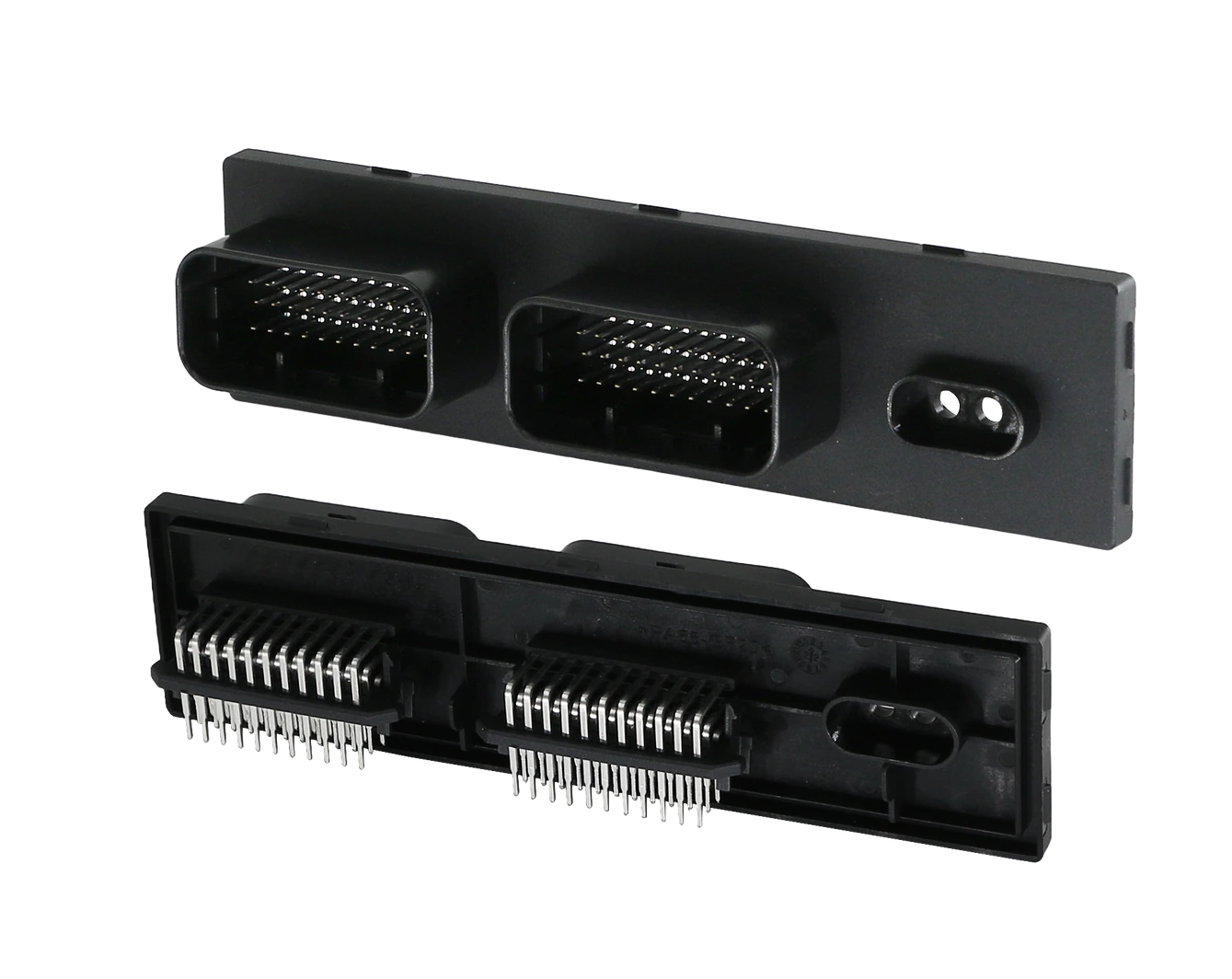
Selection criteria
Three things decide the part.
Our catalogue is organised by cavity count — but cavity count is rarely the first thing a buyer knows. These three come first, and each one narrows the table in the next section.
Where it lives
Sealed or open? Cabin or underhood? Bolted to the frame or clipped inside a panel?
- ExposureDecides sealed or unsealed: a sealed build adds a wire seal at the crimp and a grommet at the housing face; an unsealed one is smaller and cheaper for protected positions.
- Temperature classDecides the housing grade. PA66 covers most cabin and body positions; where the part runs hotter we mould in PA6T instead.
- VibrationDecides the retention. Every cavity gets a positive lock so a crimped terminal cannot back out of the housing.
How many circuits
Count the lines that have to pass through this one joint — and count the ones you may add later.
- Cavity countPicks the series. 1–9 pins is DJ70, and it runs right up to 60–66 pins in DJ76. Every series is mapped in the selection table.
- Body sizeFollows the count. A 66-pin housing needs a larger footprint and a different mating height than a 4-pin one.
- Terminal systemCan change with density, too. Dense pin fields use the smaller 0.6 mm terminal; looser layouts carry the larger tabs.
What current and wire
What flows through it, and what has to crimp onto the other end?
- CurrentSets the terminal tab width — 0.6 mm for signal circuits, wider tabs where the current is real and sustained.
- Wire rangeRuns 0.5–3.5 mm² across the catalogue. The crimp barrel has to match the conductor, not the housing.
- PlatingFollows the signal level: tin for general use, selective gold on the contact zone where a small signal makes contact resistance matter.
None of the three is unusual on its own. The work is in the combination — a 66-pin sealed housing running underhood is a different part from a 66-pin unsealed one in the cabin, even though both sit in the same series.
Selection table
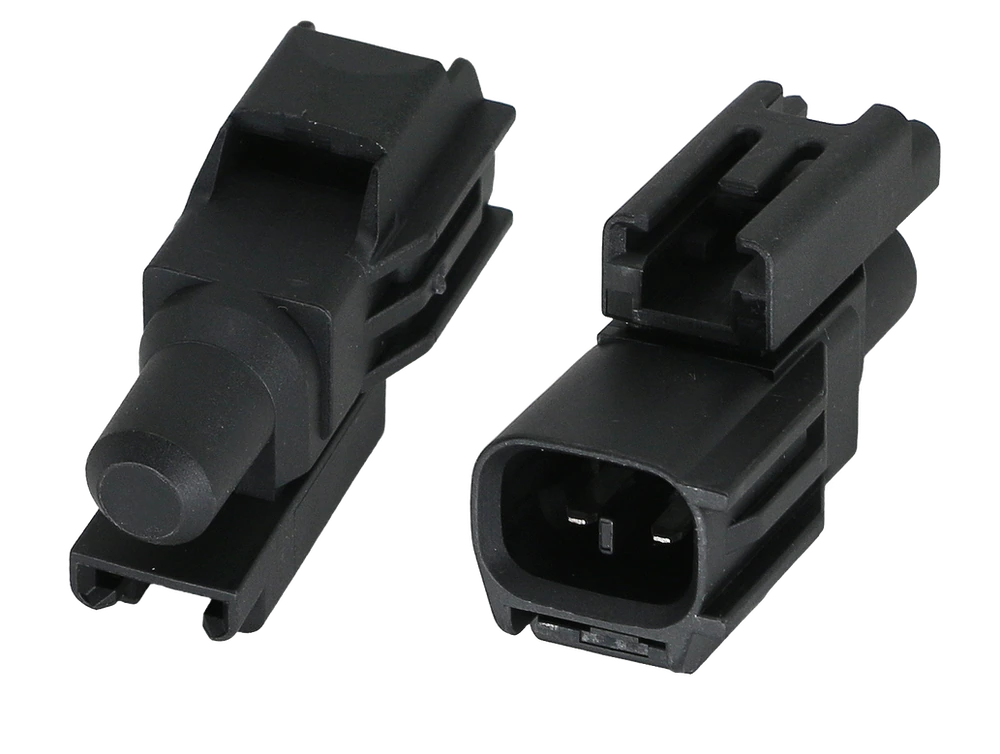
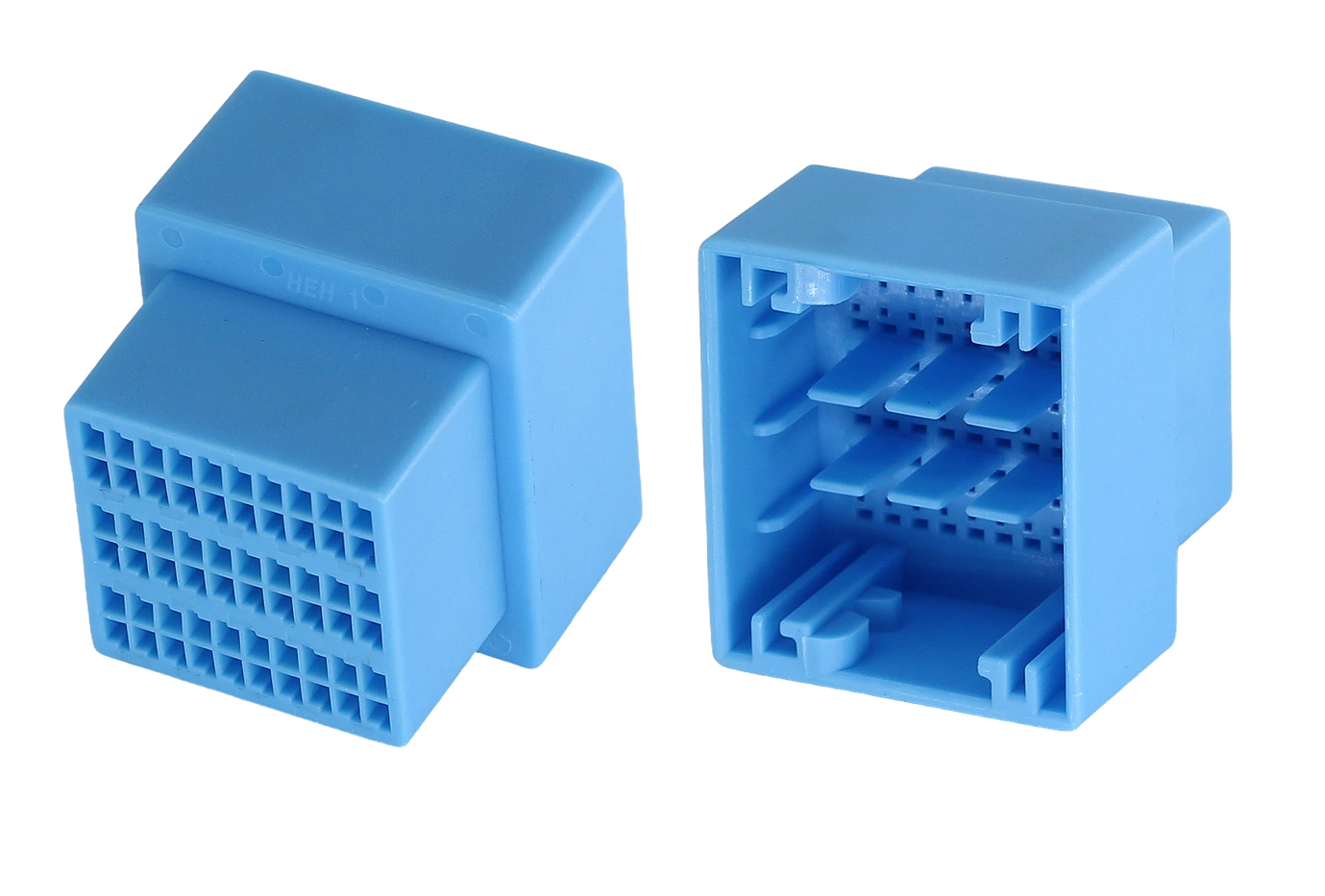
Seven series, 371 models.
Read down the pin count until it covers your circuit, then open the series. Every number here is a model that exists in the catalogue — we do not list a series we cannot ship.
The seven DJ7x series come to 325 models. Add the 14 OBD and custom-prefix connectors, the 11 terminals and the 21 tie tapes and covers, and the catalogue holds 371 models in total.
Operating environments
What the environment does to the connector.
Our parts go into three kinds of equipment. Each one attacks the connector differently, and each attack has a specific answer in the specification — usually a material, a plating or a lock.
On-board vehicle systems
Vibration, temperature cycling and road spray all act on the same joint. The failure we design against is not a cracked housing — it is contact fretting: micro-movement between terminal and tab that slowly raises resistance until the circuit drifts.
What it forces in the spec
- A positive lock on every cavity so a crimped terminal cannot back out under sustained vibration.
- Sealed or unsealed builds — sealing adds a wire seal at the crimp and a grommet at the housing face where spray actually reaches.
- A housing grade that holds its shape through thermal cycling: PA66 as standard, PA6T where the part runs hotter.
Fed byDJ70–DJ76 · 1–66 pin · 325 models
Low-voltage electrical equipment
The current is steady and there is nowhere for the heat to go. Inside a closed panel the connector runs warmer than the ambient figure on the datasheet suggests, and it stays that way for the whole service life.
What it forces in the spec
- A tab sized for the sustained current, not the peak — 0.6 mm for signal circuits, wider tabs where the current is real.
- Tin plating, which is the right trade at these current levels and keeps the cost where it belongs.
- A crimp barrel matched to the conductor across the 0.5–3.5 mm² range we tool for.
Fed byTerminals DJ611–DJ629 · 11 models
Instrumentation and metering
Here the signal is small and the current is negligible, so contact resistance matters more than ampacity. A few milliohms of drift stops being a connector problem and becomes a measurement error.
What it forces in the spec
- A phosphor bronze contact base, which keeps its spring pressure over time instead of relaxing.
- Selective gold plating on the contact zone only — where the signal actually passes, not over the whole terminal.
- Routing that keeps the harness where it was designed to sit: tie tapes, rubber covers, clips and brackets.
Fed byTerminals, plus 21 tie tapes and covers
Beyond the catalogue
When none of the 371 fits.
Most enquiries land on a model we already make — that is what seven series and 371 models are for. When they don’t, four things can usually still move before anyone cuts a mold.
We do the tooling in-house, so a new housing does not queue behind an outside toolmaker.
-
01
Interface and fit
Cavity layout, keying, panel cutout, mating height. If your mating half is already fixed, we build to it rather than the other way round.
-
02
Material
Housing grade, colour and flame class. PA66 and PA6T are our standard grades; other performance requirements are quoted against volume.
-
03
Plating
Tin, or selective gold on the contact zone. If the signal is low enough that it calls for a different contact base, we will say so.
-
04
Packaging and branding
Bulk, tape and reel, or customer-specific marking and labelling — whatever the line that receives them can take.
If none of that reaches it, we cut new tooling.
Mould, stamp and assembly all run in our own plant, so the tooling decision stays inside this building. Send the drawing and we will tell you what it takes to make it.
Send the drawing →Get a recommendation
Not sure which series? Send us the spec.
Tell us the environment, the circuit count and the wire gauge. We will name the series, the terminal and the plating — and quote it. Normally within one business day.
Quote request
Tell us the part and the quantity.
Part number or drawing, plus the volume you expect. For a new housing, the pin count and the cavity layout are enough to start — the rest we can work out with you.
Prefer not to fill a form? info@hehconnector.com+86 577 6239 9300